
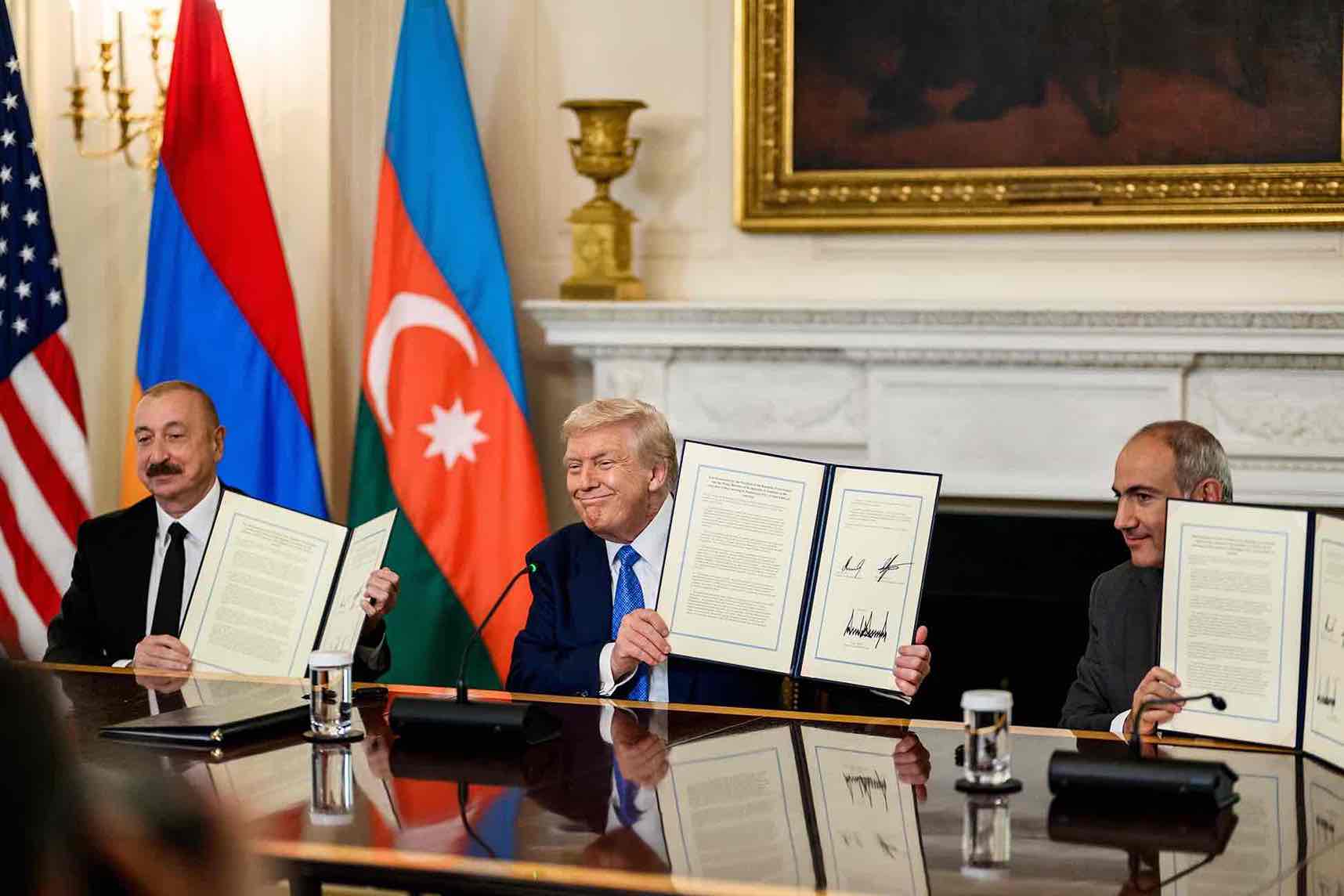
In the thirteen months since Nikol Pashinyan signed a peace declaration at the White House, the Trump Route for International Peace and Prosperity or TRIPP has bought Yerevan a comprehensive strategic partnership with Washington, a civil nuclear framework, American weapons, a founding seat at a Trump-branded international body and a presidential endorsement in a contested election. It has yet to buy a meter of track.
Having won the June 2026 parliamentary elections, Pashinyan’s government has made connectivity the organizing idea of its second mandate, and the five-year program it placed before the new National Assembly puts TRIPP near the center of the country’s economic strategy. The project provides for unimpeded multimodal transit infrastructure on Armenian territory. Its core is a 43-kilometer rail segment through the Meghri region connecting the main body of Azerbaijan to its Nakhchivan exclave, alongside road, fiber-optic, power transmission and natural gas components. Beyond that bilateral link it is intended to widen the regional routes joining Central Asia and the Caspian to Europe, which makes it a segment of the larger Middle Corridor.
What Yerevan says the project buys
Addressing parliament on 24 August on the government’s 2026–2031 program, Pashinyan said TRIPP would take Armenia out of its blockaded condition. He noted that the blockade has already been partly overcome through the peace process with Azerbaijan: Armenian cargo has moved on Azerbaijani railways through Georgia since November 2025, and the Akhalkalaki–Kars line opened to Armenian trade in May.
He also said a dedicated fund had already been created in the United States to finance the project. That vehicle is the TRIPP+ Enterprise Fund, established by a grant of 30 January 2026 and doubled by amendment on 16 July from $201 million to $402 million, with an implementation period running to the end of 2036. It is distinct from the TRIPP Development Company, which sits under the US International Development Finance Corporation.
Of the corridor’s components, the power transmission lines are the likeliest to come first: regional electricity demand is rising steadily, and transmission is the cheapest and quickest element to install. Pashinyan has said the route will threaten no neighboring state and entails no foreign military or armed presence. Sargis Khandanyan, reappointed chair of the National Assembly’s Foreign Relations Committee, has made the same point: the project requires no foreign security element on Armenian territory.
Trade is already moving
The firmest evidence that the peace is producing economic results comes from traffic already crossing Azerbaijani territory. Baku lifted transit restrictions in October 2025, and Aliyev has since reported that Azerbaijan moved 28,000 tonnes of cargo to Armenia and exported some 12,000 tonnes of its own petroleum products, characterizing the trade as a dividend of the settlement.
The shipments began in December 2025 with 1,200 tonnes of motor gasoline and grew through the winter: 2,679 tonnes of gasoline and diesel in January, 4,500 tonnes of diesel in February, further consignments in March and June, moving by rail from Bilajari toward Boyuk Kesik. Transit has carried Kazakh grain since October 2025 and Russian grain and fertilizer since March. A country Baku blockaded for three decades now buys Azerbaijani fuel and receives imports across Azerbaijani railways.
The tonnages are small; their significance is not. They establish that the two states can run a commercial relationship without waiting for the corridor, that Azerbaijan will supply a neighbor whose energy dependence on Russia is its principal vulnerability, and that unblocking has begun on existing infrastructure. They also qualify the claim that TRIPP is what ends the blockade. Goods move now. What the corridor adds is scale, the Nakhchivan link, and pipeline and transmission capacity that rail deliveries of fuel cannot provide.
Natural gas is the exception and the prize. Azerbaijan supplies Armenia with none at present, though Khandanyan has declined to rule out direct Azerbaijani deliveries and points to the TRIPP pipeline as the likelier vehicle. The stakes sit in the numbers: Armenia buys Russian gas at $177.5 per thousand cubic meters against a European price near $550, and Moscow has warned Yerevan it may terminate the 2013 supply agreement unilaterally should Armenia continue toward EU membership. Cheap Russian gas is the instrument Moscow retains, and the threat to withdraw it is why diversification has moved from aspiration into planning.
The terms of the deal
Foreign Minister Ararat Mirzoyan has said Armenia will retain full sovereignty and jurisdiction over state border management, border control and customs administration for all customs procedures on its territory under TRIPP. The corporate architecture is more complicated than that formula conveys. Under the framework agreement initialed in Yerevan on 26 May 2026 and signed on 1 and 4 June, the TRIPP Development Company receives land use rights for 49 years, with an option to extend by a further 50. For the initial term the United States holds 74 percent of the company and Armenia 26; on extension Armenia’s share rises to 49 percent without additional investment or obligation. The company may create subsidiaries and bring in further partners.
Customs sovereignty and majority foreign ownership of the operating company for half a century describe different things, and the distinction is the substance of the domestic argument about the project. The agreement is also not yet law: the government approved the ratification bill on 16 July, and Khandanyan expects the Constitutional Court to take it up in September, with a parliamentary vote to follow.
The peace treaty underpinning the corridor is unfinished on a related point. Baku has withheld signature pending a change to Armenia’s constitutional preamble, which incorporates the 1990 Declaration of Independence and through it the 1989 act on unification with Nagorno-Karabakh; Aliyev told the Munich Security Conference in February that once the amendment is made, “we can sign the peace agreement the very next day.” Pashinyan has accepted the substance, announcing a “Fourth Republic” on 24 August whose new constitution would drop the Declaration. Removing it requires a referendum, putting a draft to referendum requires two-thirds of the National Assembly, and Civil Contract returned from the June election with 64 seats and no date set. TRIPP ratification needs a simple majority the government has; the treaty behind it needs a threshold the government does not.
What the corridor has bought in Washington
The corridor has moved the US–Armenian relationship further than it has moved any cargo. It began with a trip: Pashinyan went to the White House on 8 August 2025 to sign a peace declaration with Ilham Aliyev, with Trump as witness, and came away with a transit project named for his host. A year later, on 8 August 2026, the two leaders marked the anniversary by telephone and reaffirmed their commitment to begin construction.
What accumulated between those dates outweighs the symbolism. On 22 January 2026, at Davos, Armenia signed the charter of Trump’s Board of Peace as a founding member — the body created to oversee Gaza’s transition and since broadened into a general forum on peace practice. The $1 billion permanent-membership fee was waived; invited states may take part without charge for up to three years. Pashinyan said on 30 April that Armenia would instead make voluntary contributions scaled to its means, and declined to name a figure. Azerbaijan signed alongside.
On 9 February, Vice President JD Vance came to Yerevan and signed a joint statement completing negotiations on a civil nuclear cooperation agreement, opening the way to American small modular reactor technology. The same visit confirmed Armenia’s purchase of V-BAT unmanned aircraft through the Foreign Military Sales program, building on the Eagle Partner exercises.
On 26 May, Secretary of State Marco Rubio initialed the TRIPP framework agreement in Yerevan and signed two others: a Charter on Comprehensive Strategic Partnership, upgrading the partnership charter of January 2025, and a framework on securing supply in critical minerals and rare earths. The charter’s scope is wide — civil nuclear technology and small modular reactors, semiconductor supply chains and artificial intelligence, space cooperation and the Artemis Accords, sales of defense articles and military education, cyber resilience, and reconstruction of the Gyumri–Kars railway. Two days later Trump endorsed Pashinyan for the June election under the slogan “Make Armenia Great Again.” Pashinyan won.
Within ten months Armenia acquired a comprehensive strategic partnership, a civil nuclear framework, a critical minerals agreement, American weapons through FMS, a founding seat at a Trump-branded international body, and a public presidential endorsement in a contested election. Set against a Russian relationship in open dispute over the railways and an Iranian frontier that has become a war border, that is a substantial return, and the corridor generated it.
The return carries its own exposure. The relationship is built around one American president and a project bearing his name, and Armenia has taken a public position inside his political idiom. An endorsement is also an intervention, and the opposition has said so. Arms sales and joint exercises fall short of a defense commitment: the charter promises cooperation, not protection. The whole structure rests on a corridor that has not been ratified, funded or built, and if TRIPP stalls, what remains is a set of agreements whose political premise has gone.
August continued in the same direction. US Representative Abraham Hamadeh visited Yerevan, meeting Pashinyan and then Speaker Ruben Rubinyan, with whom he discussed inter-parliamentary cooperation and the unblocking of all South Caucasus transport routes, TRIPP included, alongside humanitarian questions. He also met Alen Simonyan, appointed Secretary of the Security Council on 13 August in place of Armen Grigoryan. Separately, Deputy Foreign Minister Vahan Kostanyan, his Azerbaijani counterpart Elnur Mammadov and US Under Secretary of State for Political Affairs Allison Hooker held a trilateral meeting in Washington on 11 August at which the corridor was among the subjects.
The railway problem
Against this background Pashinyan has again pressed Russia to transfer management of Armenia’s rail network to a third country acceptable to both Yerevan and Moscow. His stated argument is commercial: international shippers and investors avoid Russian-managed infrastructure because of sanctions exposure, and Armenia stands to lose substantial revenue from precisely the regional transit routes TRIPP is meant to open. He has said he would prefer a friendly settlement with Moscow.
Russian Railways operates the entire network through its South Caucasus Railway subsidiary under a 30-year concession running to 2038, and Moscow has rejected the proposal outright. Deputy Prime Minister Alexei Overchuk warned of countermeasures against Armenian businesses in Russia; RZD expects repayment of roughly $396 million invested should Armenia reclaim control. Yerevan floated a charge of some $2 billion a year for use of the infrastructure. Pashinyan has not ruled out arbitration. The corridor’s value to Armenia depends more directly on this question than on any other, and it is nowhere near settlement.
Moscow’s case against
Russia has made its displeasure plain. Mikhail Kalugin, director of the Russian Foreign Ministry’s Fourth CIS Department, has argued that implementation faces both geopolitical and infrastructural difficulty, citing the presence of Russian border guards on the Armenian–Iranian frontier, the need for Russian-standard track gauge to integrate with Azerbaijani infrastructure, the South Caucasus Railway concession running to 2038, and Armenia’s membership of the EAEU and its single customs space. These points are self-serving and substantially factual at the same time. Three of the four are legal or physical facts rather than positions, and the gauge question admits of no cost-free answer.
Tehran, and the war
Iran’s objection is as old as the project. On 9 August 2025, the day after the White House declaration, Ali Akbar Velayati — then senior adviser on international affairs to Supreme Leader Ali Khamenei — told Tasnim that such a corridor “will turn into a graveyard of the mercenaries of Donald Trump, not a route owned by the US president.” Tehran’s formal position was framed in the language of red lines, and after President Masoud Pezeshkian’s visit to Yerevan later that month Foreign Minister Abbas Araghchi said Armenia had given specific assurances: that Iran’s red lines on Zangezur would be upheld, that no US forces would be stationed on the Iranian–Armenian border, that the builder would be an American company registered under Armenian law, and that security would be provided by Armenia alone, with no private American security firms admitted. Those four pledges are the substance behind the government’s “no foreign presence” formula, and Tehran will measure the project against them.
The objection was restated at the end of 2025, when Velayati, in meetings with Armenia’s ambassador in Tehran, stated Iran’s disagreement with what he called Trump’s plan for the Caucasus, identifying it with the Zangezur corridor. Tehran’s declared concerns are the prospect of border changes and the loss of its land connection with Armenia, sharpened by reports that long-term management of the route would pass to the United States. Iran has promoted the Aras corridor through its own territory as the preferable alternative. Armenian officials rejected the objections, replying that the project is commercial and takes account of neighbors’ vital interests, Iran’s included.
Those exchanges belong to a political order that no longer exists. Khamenei was killed in US–Israeli strikes on 28 February 2026, and Mojtaba Khamenei was named Supreme Leader on 8 March; the American campaign has continued, with further strikes in May. The war has already reached the corridor’s geography: a drone struck Nakhchivan on 5 March, Azerbaijan blaming Iran and Iran denying responsibility. Iranian policy toward TRIPP is now made under conditions that no statement from December 2025 anticipated, and citing that statement as Tehran’s current position is no longer safe.
A corridor under American majority ownership within striking distance of the Iranian border plausibly does make southern Armenia a target, and calling the claim pro-Iranian alarmism does not dispose of it. Yerevan is visibly hedging: Armenia and Iran spent July 2026 drafting a comprehensive strategic partnership agreement, which is hard to reconcile with a reading of TRIPP as Armenia’s exit from the Iranian relationship. Reducing dependence on Tehran and deepening treaty ties with Tehran are being pursued at once, and the government has not been asked how both can be true.
The Armenian debate
Domestic commentary has been readier than the government to treat the corridor as a choice with costs on both sides. Ashot Nersisyan, professor and head of the Zoravar Sepuh historical-political analytical center, argues that TRIPP can benefit Armenia because it widens the country’s transport and economic options and reduces dependence on any single external center, and that Armenia should judge the project by its own national interest rather than by whether it suits Russia, Iran, Turkey or Azerbaijan:
“If the TRIPP agreement offers the chance to widen Armenia’s communication options, reduce dependence on a single center and integrate the country into broader international economic and political systems, then refusing that chance for the sake of Russian or Iranian geopolitical interests would mean, once again, allowing the interests of others to prevail over those of one’s own state.”
The analyst Tigran Dumikyan makes a related point about the project’s political rather than commercial value:
“The international agenda around the TRIPP project shows that this is not simply a transport project. If it is implemented according to the logic envisaged, it could change the existing structure of communications in the South Caucasus, creating new links between Armenia, Azerbaijan and other countries of the region… TRIPP’s political value is already evident. An international agenda has formed around it, it has become one of the important symbols of the agreements reached between Armenia and Azerbaijan, and its possible implementation is of interest not only to the immediate parties.”
Mirzoyan has put the government’s version of the same thought more expansively. In a television interview on 4 June he said Armenia is turning “from a transport dead end into a bridge between East and West at a time when the world is looking for new logistics routes,” becoming an important junction and a crossroads of peace. His fuller argument was more cautious than the summary usually attributed to him: the durable guarantee of any agreement, he said, is that it remains advantageous to both parties, since third-party guarantors pursue interests of their own.
The corridor as its own guarantee
Infrastructure serving enough parties acquires protection from the number of interests riding on it. That is the strongest answer available to the fear that TRIPP turns Syunik into a target, and the government makes it only in passing. A route that matters to Washington, Brussels, Ankara, Baku, Astana, Beijing and the Gulf is not a route any single actor can close without answering to all of them at once. The guarantee is written into no treaty; it is a function of how many governments would find their own interests damaged by an interruption, and of what they are prepared to do about it.
Hormuz shows both halves of that proposition. When Iran began closing the strait after the strikes that killed Khamenei on 28 February 2026, the response was not bilateral: France and Britain assembled a mine-clearance coalition from March, the United States ran an air campaign and blockaded Iranian ports, and mediation produced the Islamabad Memorandum in mid-June, after which the blockade was lifted and tankers began moving again. A chokepoint carrying everyone’s cargo generates a coalition, and the precedent runs back to the reflagging of Kuwaiti tankers under Operation Earnest Will in 1987 and the destruction of much of Iran’s navy in a single day in April 1988.
The coalition did not restore the route quickly. Traffic remains far below pre-war levels more than six months after the first closure, held down by mines, war-risk insurance and repeated breakdowns in the ceasefire. Interest density bought an enormous mobilization and a slow, partial recovery.
Georgia is the regional test, and the record there is more ambiguous than the argument’s advocates allow. Russia did not leave Georgia’s east–west infrastructure alone in August 2008: its forces took Gori, astride the main east–west road, and cut the country in two, and the Baku–Tbilisi–Ceyhan pipeline went out of service after an explosion at Refahiye in Turkey on 5 August, claimed at the time by the PKK and later assessed by US intelligence as probable Russian sabotage. Bombs also fell near the pipeline’s route during the fighting.
The trunk infrastructure was disrupted rather than destroyed. The pipeline was flowing again within weeks, the highway was given back, and the corridor Moscow had every strategic reason to eliminate carries more traffic today than it did before the war. A Russian government willing to invade a country and occupy its central road junction stopped short of permanently destroying a pipeline belonging to BP, Azerbaijan and Turkey with Washington behind it. Interest density bought a ceiling rather than immunity.
For Armenia the ceiling is the operative fact. Interest density deters permanent destruction considerably better than it deters harassment, and it is unevenly reliable even then: Nord Stream was multinational infrastructure with dense stakes at both ends, and it was destroyed in September 2022 with no state held to account in the years since. What separates the cases is whether a power with the capability to enforce also carried a standing, declared commitment to do it.
That commitment is the one thing the corridor does not yet contain. Armenia has a charter of comprehensive strategic partnership, arms purchases and an American majority stake in the operating company. It has no statement from any government that an interruption of the route would be met with a response. Many interests protect a corridor only when somebody will act on them, and Yerevan has not asked anyone to say so out loud.
What TRIPP cannot do yet
The case for the corridor as an engine of Armenian growth requires four things: ratification, financing, construction, and a region calm enough to carry cargo. None is secure.
Financing is the nearest constraint. Transport specialists estimate the rail segment alone at $250–400 million, and the $402 million now in the TRIPP+ fund is an opening tranche against a bill that also includes a highway through mountainous terrain requiring long new tunnels, for which no funding has been identified. The larger multibillion-dollar structure is still being assembled.
The commercial case is unproven rather than established. A 2026 European Commission study puts the time saving at roughly 25 percent against the existing Baku–Tbilisi–Kars railway, a real improvement, but BTK has remained underused since its 2024 upgrade, which suggests the binding constraint on Middle Corridor volumes is demand and border process rather than distance. A route a quarter faster than an underused route is not self-evidently a growth engine.
Energy diversification remains a prospect. The TRIPP gas pipeline has no supplier contract and no construction timetable, and Khandanyan’s accompanying remark — that if the price of Russian gas were revisited Armenia would “discuss the question amicably with Russian partners” — describes where the leverage currently sits.
The blockade is real, the commercial cost of Russian-managed rail is measurable, and a government returned to office on this program has a mandate to pursue it. The corridor has also paid already, in a strategic partnership, a nuclear framework, a minerals agreement, a defense relationship and the first Azerbaijani fuel to reach Armenia in three decades. What Yerevan holds beyond that is an unratified agreement, a partially funded fund, an unsigned peace treaty, a constitutional referendum without the votes to call it, and 43 kilometers of unbuilt track in a region at war. Whether those become the engine of national development the government’s program describes depends on ratification votes, construction contracts and a security commitment nobody has yet made.
Michael Borodkin is an analyst with the Jerusalem Institute for Strategy and Security (JISS), focusing on Iran and regional power competition. A historian and geopolitical analyst specializing in Iran and the Middle East, he regularly publishes analysis based on open-source research and regional monitoring.
Themes: Economy,Caucasus,Connectivity,United States,Armenia,Middle Corridor,Azerbaijan