
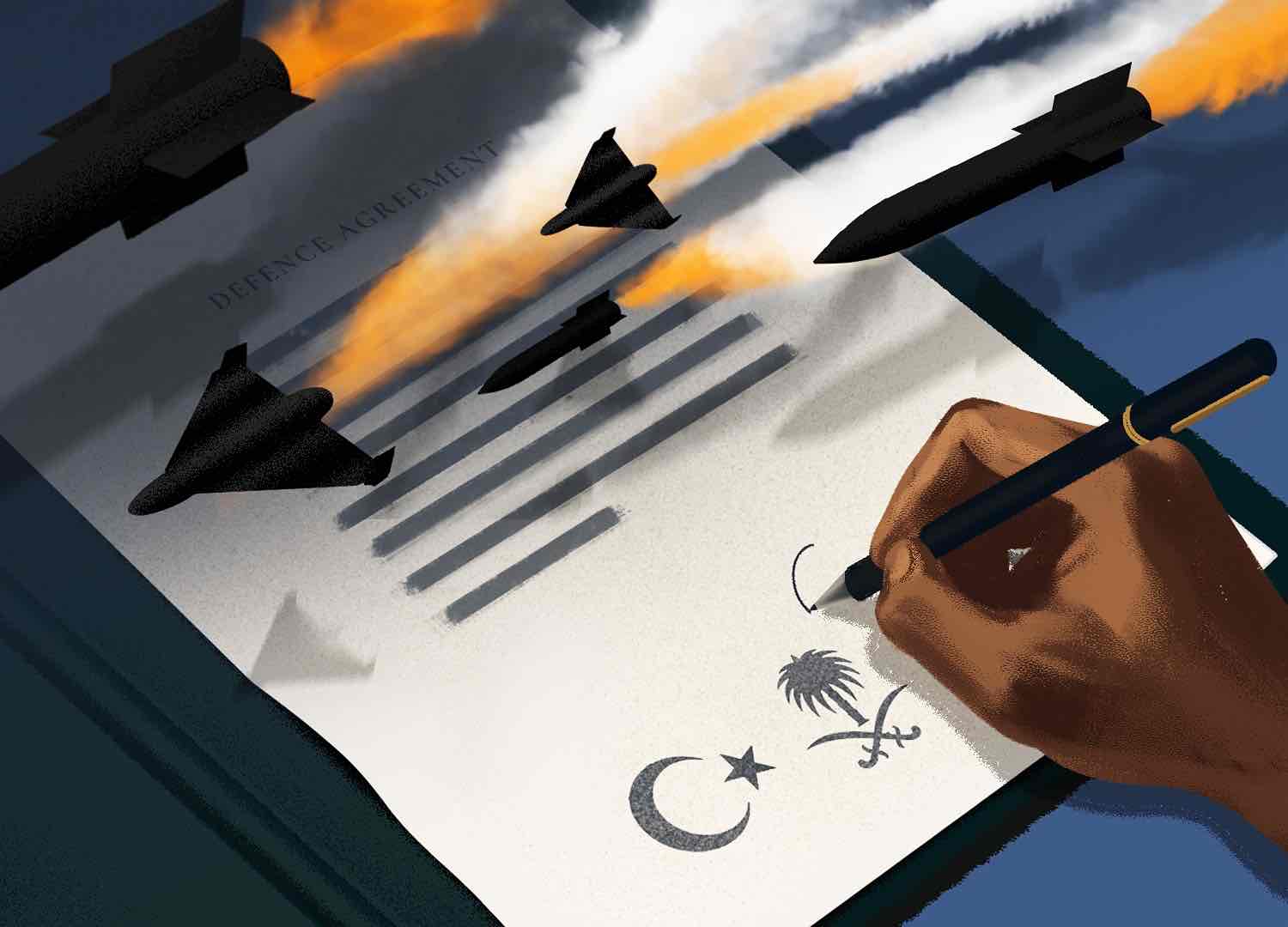
Illustration by Dinmukhamed Kairulla.
Saudi Arabia, Turkey and Pakistan signed a mutual defense treaty in Mecca on August 7. Two days later, Houthi drones struck the Aramco refinery at Jizan. Ankara and Islamabad said nothing, and by the terms of the document they had just signed, they owed nothing.
The Makkah Joint Defence Agreement borrows the vocabulary of collective defense — an armed attack on one treated as an attack on all — and applies it to a relationship that has run for six decades as a contract for services, exchanging Pakistani manpower and instruction for Gulf money and diplomatic cover. The agreement answers the threat Riyadh fears, a state strike of the kind Israel delivered against Doha last September, through a mechanism that triggers nothing automatically. It is silent on the threat Riyadh absorbs week after week. Both features are deliberate, and together they explain what the pact was built to do.
Signed by Crown Prince Mohammed bin Salman, President Recep Tayyip Erdoğan and Prime Minister Shehbaz Sharif, the agreement provides for a ministerial committee, political and military committees, and a permanent secretariat in Saudi Arabia, with operational procedures left to be determined. Turkish Foreign Minister Hakan Fidan called the arrangement "technically" equivalent to NATO's Article 5.
The pact was tested immediately. Days after Jizan, Houthi forces struck the commercial vessel Tihama in the Bab al-Mandeb, killing six crew; Pakistan's foreign minister confirmed on August 12 that three of the dead were Pakistani nationals. Islamabad still made no move. The Houthis went on to claim a third strike on the same refinery inside two weeks. Riyadh's operational answer ran through an entirely different instrument: the fourteen-nation Multinational Maritime Defense Alliance, announced on July 30 and launched in Jeddah on August 13, built for intelligence exchange, operational planning and joint naval exercises. Turkey and Pakistan both joined it as founding members. A similar pattern persisted after September 9 when Houthis targeted Saudi Arabia’s southern Saudi cities of Abha, Khamis Mushait and Jazan.
What the signatories actually promised
The full text of the Mecca agreement has not yet been published. The communiqué does not define aggression, assign forces, establish an integrated command, or state whether assistance would be automatic. It is silent on cyberattacks, maritime blockades, proxy operations, and retaliation following an offensive action by one of its members.
Fidan's description of the mechanism tells more than just an Article 5 comparison. Assistance is not automatic: an attacked state must request help and specify what it needs, from intelligence through to deployment, and the partners then determine the nature and scale of any response. This is a consultation clause with a request trigger, and it places the burden of asking on the victim.
Ankara has signed language of this kind before, and it has already been tested. The Shusha Declaration of June 2021 commits Turkey and Azerbaijan, where either party perceives a threat or act of aggression against the other's sovereignty or territorial integrity, to "hold joint consultations" and "provide each other with the necessary assistance," after discussing "the volume and form of such possible assistance." On March 5, 2026, Iranian drones struck Razi airport in Nakhchivan. Turkey answered with a Foreign Ministry statement of condemnation; the Azerbaijani president Ilham Aliyev called the strike an act of terror. No Turkish military action followed. Five months later the Mecca communiqué reproduced the same architecture — perceived threat, consultation, assistance to be defined in the event.
Precedents
Mecca expands the Strategic Mutual Defence Agreement signed in Riyadh on September 17, 2025, by Mohammed bin Salman and Shehbaz Sharif, which declared that "any aggression against either country shall be considered an aggression against both." That text was never published either, and it came eight days after the Israeli strike on Doha. Mecca reproduces its formula almost word for word, which suggests a document inherited rather than drafted for a trilateral.
Formal Saudi-Pakistani military arrangements reach back further, to a 1982 protocol under which Pakistan stationed more than ten thousand troops in the Kingdom. Turkey and Pakistan have their own treaty history: the 1954 Agreement of Friendly Cooperation, followed by both states' membership in the Baghdad Pact of 1955 and its successor, CENTO. Saudi Arabia opposed the Baghdad Pact at the time, siding with Nasser.
CENTO bears most directly on what Mecca is likely to deliver. It was a standing mutual security framework containing two of the three current signatories, with an institutional apparatus considerably more developed than anything announced in August. It produced nothing for Pakistan in the 1965 war with India, and nothing in 1971. Its members honored their commitments only where interests already coincided, which is another way of saying they had made no commitments.
Fidan has offered the pact's two years and eight months of development as proof that it is no improvised reaction to the war with Iran. The stronger version of that argument is the Saudi-Turkish reconciliation of 2021 and 2022, which had to be completed before any such document became possible. Riyadh and Ankara spent the preceding decade on opposite sides of the region's principal disputes — over the Muslim Brotherhood, over Qatar, over Khashoggi. What changed was not the threat environment alone but the fact that the two governments stopped working against each other.
What Pakistan has actually provided the Gulf
The agreement is being read as Pakistan extending a security guarantee to Saudi Arabia. Six decades of practice describe something narrower and more durable.
Pakistani training missions have operated in the Kingdom more or less continuously since the 1960s, and Pakistani pilots reportedly flew Saudi aircraft against South Yemeni incursions in 1969. Pakistani Air Force pilots also flew for Jordan, Iraq and Syria during the 1967 war.
Jordan shows most clearly what the arrangement delivered. A Pakistani expert team reorganized and retrained the Jordanian army in the late 1960s, and when the confrontation with the PLO came in September 1970, King Hussein sent Brigadier Zia-ul-Haq to assess the fighting on the ground. By the CIA's own history of the episode, Zia "effectively took charge of part of the Jordanian counterattack." Pakistani officers helped a monarchy survive an internal challenge, and the officer in question went on to rule Pakistan.
The pattern held in Saudi Arabia. Pakistani instructors had been preparing Saudi security forces before the 1979 seizure of the Grand Mosque, but when the siege came, Riyadh declined Pakistani and Jordanian offers to send troops into the sanctuary and worked instead through French advisers.
The 1982 deployment states the relationship's purpose most plainly. More than ten thousand Pakistani troops served in the Kingdom, including an armored brigade at Tabuk, and Riyadh specified the sectarian composition of the units it received. Governments do that with a praetorian guard, not with an allied expeditionary corps. Bahrain has run a smaller version of the same arrangement for years, recruiting Pakistani ex-servicemen into its National Guard and riot police, whose part in the 2011 crackdown drew comment across the region.
Where a state adversary has been involved, Islamabad has declined. Pakistan contributed a contingent to the defense of Saudi Arabia during the 1990-91 Gulf crisis while keeping it out of the offensive to retake Kuwait. In April 2015, asked to join the Saudi-led campaign in Yemen, Pakistan's parliament voted unanimously for neutrality; the United Arab Emirates' Anwar Gargash warned publicly that Pakistan would pay a heavy price for what he called an ambiguous stand. Two years later Islamabad sent Raheel Sharif to command the Islamic Military Counter Terrorism Coalition in Riyadh, and in 2018 it deployed about a thousand personnel on training and advisory duty. Pakistan has supplied manpower, instruction and command appointments without interruption for sixty years. It has never fought a state on the Gulf's behalf.
Read against that record, the silence after Jizan is what the relationship has always produced.
What the pact does deliver
The substantive content is industrial, and most of it predates the signature. Baykar's 2023 contract with Saudi Arabian Military Industries for Bayraktar Akinci systems, the largest defense export in Turkish history, carries technology transfer and local assembly in the Kingdom. Riyadh is in advanced negotiations over participation in the KAAN fighter program, which Turkish Aerospace described in February as entering its final stages. Co-production of this kind feeds the Kingdom's target of localizing half its military spending by 2030, a goal no volume of American arms sales advances. For Turkey it secures capital and an export anchor for its two most important defense programs. For Pakistan it consolidates a relationship that has repeatedly cushioned its balance-of-payments crises.
The political content is a message, and its recipient is Washington rather than Tehran or Sanaa. Gulf capitals drew a conclusion from the war between the United States and Israel on one side and Iran on the other: American bases in the region serve as targets and as tripwires for escalation at least as much as they serve as protection. The pact registers that conclusion in a form Washington cannot ignore.
The message should not be mistaken for an alternative security architecture built on regional capabilities alone. Turkey is a NATO member. Pakistan is a major non-NATO ally. Saudi air defense, command and control, and the great majority of the Kingdom's platforms are American, and roughly fifty thousand American troops remain deployed across the region. President Trump welcomed the agreement on Truth Social, writing that it showed "the Middle East is coming together and how Countries will finally be able to defend themselves in a more meaningful way." An arrangement the incumbent guarantor endorses as burden-sharing is no hedge against him.
That endorsement is not merely rhetorical. If the pact raises the region's capacity to handle its own contingencies, Washington gains what every administration for three decades has sought and none has achieved: a smaller Middle Eastern commitment. With competition with China now the organizing objective of American strategy, resources released from this theater have somewhere to go. The Mecca signatories and the United States may be pursuing the same outcome for opposite reasons.
The Abraham Accords sought to reorder the region through normalization, underwritten by an external power and powered by economic incentives, and they have run into the limits the war in Gaza imposed. Saudi-Israeli normalization now looks distant, Pakistani-Israeli normalization more so, and Turkey's relations with Israel have deteriorated badly. Mecca proposes a different organizing logic, security relationships among Muslim-majority states rather than diplomatic arrangements brokered from outside. So far it has demonstrated a competing vision rather than a competing capability.
The mismatch
The pact addresses the contingency Riyadh fears — a state strike of the kind Israel delivered against Doha in September 2025 — through an instrument with no automaticity, no defined trigger and no command structure. It is silent on the contingency Riyadh absorbs week after week. The threat the agreement was written to deter and the threat the Kingdom actually faces are different threats, and a separate fourteen-country coalition is already handling the second.
What the agreement provides is institutionalized ambiguity. It makes an adversary uncertain about the cost of attacking a member, and it gives three governments more room to negotiate with the great powers at a moment when confidence in American protection has thinned. Both effects can be produced without the mutual defense clause ever being invoked, which remains the most likely course.
Emil Avdaliani is a research fellow at the Turan Research Center and a professor of international relations at the European University in Tbilisi, Georgia. His research focuses on the history of the silk roads and the interests of great powers in the Middle East and the Caucasus.